St. Louis November 1898
Adolphe insisted that our larger home required a full-time housekeeper, so we took on a young Dutch woman named Alvina. It took some adjustment on my part, but as usual Adolphe charmed Vena into putting up with my eccentricities. We soon found an agreeable division of labor, and it was enlivening to have a young person in the house again.
After my term as president ended, I remained active with the Association. Our society hosted lecturers on all manner of science and medicine, and I found that the more I learned, the more I could absorb. I was finally getting the education I had long been denied. I used my influence in the group to gradually steer us away from paranormal topics in favor of more urgent earthly issues—women’s suffrage, schooling for our black neighbors (of which we had many living in our new neighborhood), and a growing support for Prohibition. The latter was not of much importance to me personally—my husband did not share his countrymen’s fondness for beer—but I supported any effort to free women from the tyranny of spouses who abused them.
My favorite subject was astronomy, and I often wrote letters of invitation to speakers on the subject who I thought might be willing to travel to St. Louis. I had secured a coup today, as my most desired lecturer had consented to visit us as part of a larger speaking tour. I arranged for Alberton and me to sit in the front row, where he might better hear the talk.
When my friend arrived I was awaiting him in the lobby. “I should warn you,” I said, “You have come during the pre-lecture ‘wing’ exercises.”
Inside, Adolphe stood at the podium translating aloud from a German physical culture manual. The usual seating was pushed back to make room for grown men and women, in their best Sunday attire, gamely pinwheeling their arms. Our group lacked the necessary sense of rhythm, and while we observed the spectacle, one man managed to accidentally punch another in the eye.
“Hmm,” was all Alberton had to say.
“The theory goes that the mind and body are deeply connected, so they say this will unlock hidden potential in one’s attunement to the spirit realm.” I paused. “It also aids with circulation.”
Adolphe decided enough damage had been done and the men proceeded to set up the seats for the lecture. I was too awestruck to do the introduction myself, so I had asked our current president, Reverend Thomas Grimshaw, to do so on my behalf. Rev. Grimshaw was young, clean-shaven, and had risen fast in our organization. We held very different views on Spiritualism itself—he exhibited all the enthusiasm of a recent convert to the cause—but did not oppose me in introducing more secular topics. I liked him very much.
“Thank you all for being with us today on this important anniversary,” he said. “And a special thank you to former president Mrs. Weiss for bringing this popular speaker to us today. I’m very pleased to introduce astronomer Percival Lowell, here to tell us about his latest discoveries about our neighbor, the planet Mars.”
Mr. Lowell ascended to the stage. He was renowned for his magnetic presence—something about his bearing captured the attention of the crowd so thoroughly that not another sound could be heard in the hall. He was in his late 40s and already quite bald atop his head, with a very prominent moustache which ended in finely-waxed points. He had deep-set and expressive eyes that lit up as he spoke, and his Boston Brahmin accent was prominent.
“The value of a lecture,” he began, “consists not so much in the body of learning it may impart, as in the inspiration it gives others, to pursue knowledge for themselves. I hope my words today will so guide you.” His gaze swept across the room and alighted, I felt, on me.
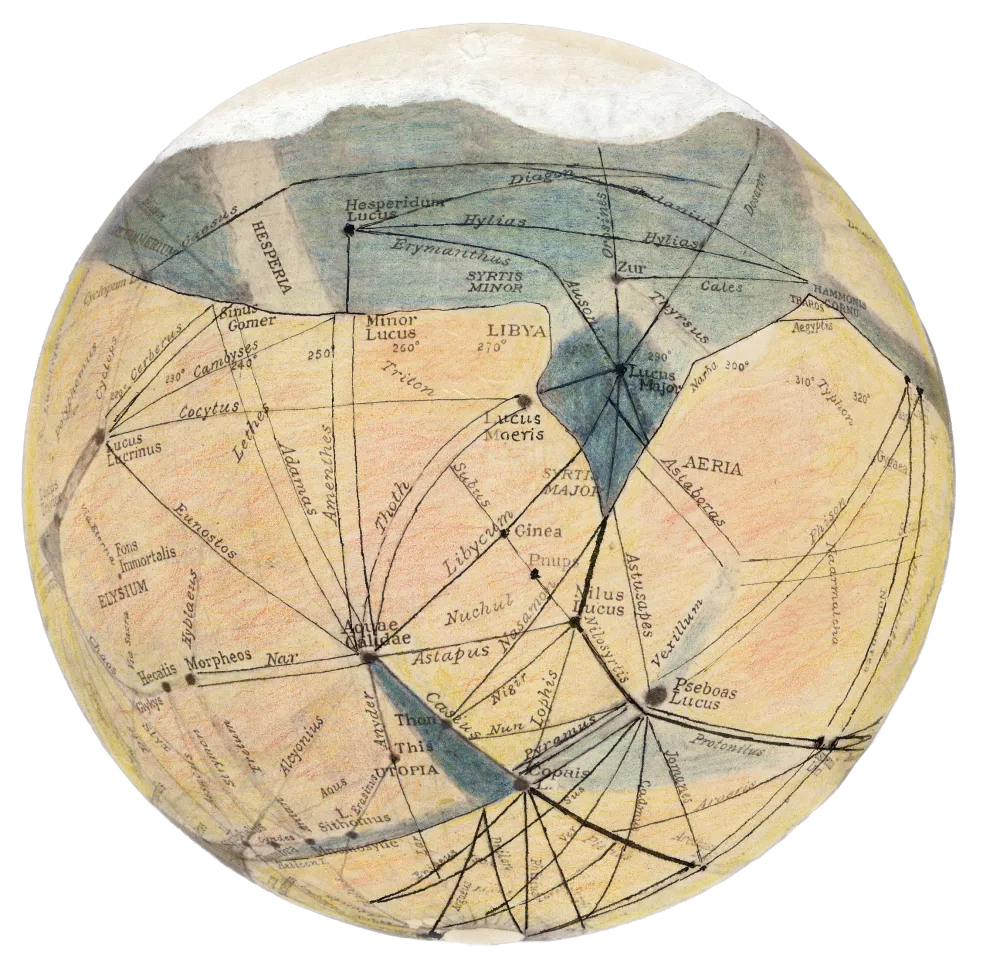
Mr. Lowell had brought on stage large placards with reproductions of his drawings of Mars. His renditions were painstakingly produced over months of observations through the telescope he had built in Arizona territory. With these images, he said, “We shall be gazing upon details of Martian geography never ’till now seen by man. We may thus make a far journey without leaving home, and from the depths of our arm-chairs travel in spirit to lands we have no hope of ever reaching in body.”
I had read of his discoveries of a network of canals, but to see them laid out in his own hand was quite extraordinary—radiating lines that converged at points, enmeshing the planet. In his drawings, the surface of Mars evoked a fragile glass globe that had been delicately fractured. He hypothesized that these lines represented irrigation channels designed to bring water from the icy poles to the arid interior, and that without the canals, the people of Mars would surely starve.
Sara—Through nearly all of the streets are canals spanned at intervals by handsome bridges, so ornamental, so apparently unsubstantial, that it seems surprising that they sustain the weight of the numerous vehicles and multitudes of people passing over them. The margins of the canals are lined with great palmlike trees, whose leaves are in incessant motion, and as the pretty, passenger laden and other boats glide along under their rustling branches they seem to be whispering to each other. And, dear me, see those lovely, lovely flowers, growing all along the margins of the Waterways, their rich, glossy green leaves and great snowy blooms trailing down the walls and onto the water, where they rest like enthroned Queens of the flower world. Yes, I perceive their aura, and how wonderful it is. Please take me nearer, so that I may see them more clearly.
Page 406
“The regularity of these canals is near proof that some intelligence has been at work. Quite possibly, such Martian folk are possessed of inventions of which we have not dreamed. For them, electrophones and kinetoscopes are things of a bygone past, preserved with veneration in museums as relics. Certainly what we see hints at the existence of beings who are in advance of, not behind us, in the journey of life.”
He was truly a captivating orator, though as his lecture progressed I started to feel the same queasy uncertainty I did during the many seances I had attended. He had much to say about the existence of life on the planet, but it seemed to be largely conjecture. I could accept his observations as fact, but beyond that, who could say what these lines represented?
“We must free our minds from the shackles that, of necessity, tether our bodies,” he concluded. “We should recognize the possibility of other intelligent beings to the same degree that we accept the certainty of ourselves.” The response from our audience was naturally very enthusiastic; Spiritualists are already quite certain they are not alone. My natural shyness and mild disappointment meant I did not approach Mr. Lowell after his lecture.
“What did you think?” Alberton asked me.
“I felt his extrapolations ran somewhat ahead of his observations. Perhaps these canals were built by an intelligence, but an ancient one long extinct. Or perhaps the accepted laws of geology on Earth do not apply on other planets, and these were natural features after all.” I hestitated, not trusting my own unlettered judgment. “My imagination is fired up, though I’m not sure how much I have learned about Mars.”
When a townhouse on our block went up for let, I invited you and Ada to stay near us for an extended visit. I was especially delighted to spend time with you again, Claire, as you were now a bright young woman of twenty, ready to explore the world.
Ada re-entered St. Louis society like a whirlwind. Her high status in New York and Chicago automatically ranked her among the upper echelons of our more provincial city. I rarely accompanied her to the grander parties, but Adolphe often did—neither of them would pass up an opportunity to dress to the nines.
On the night of the Veiled Prophets ball, I went to your apartment to help Ada prepare. You and I selected for her an elegant white satin gown, with an embroidered black velvet panel and vest, and a set of diamond earrings and necklace that Chauncey had bought for their anniversary. It was not an outfit I would wear myself—I avoid mourning colors, and I prefer colorful gems over diamonds—but my daughter looked splendidly regal.
Adolphe took almost as long for his own toilet as Ada did, and by the time he came round to escort her, it was already quite late. You and I took the opportunity to stay up into the wee hours gossiping like schoolchildren. You told me how you struck up a friendship with Mrs. Boogher’s niece Martha, and had been very pleased to be invited to one of her aunt’s famous receptions.
“But when I arrived,” you said, “Martha and I were assigned to dispense the punch and fruit ices!”
“Oh no!” I replied. I was thinking about how at your age I was already a mother several times over, and how glad I was that you’d avoided my fate.
“We had to know who to serve in what order based on their standing, but I hardly knew who anyone was! Then there was the matter of all this sticky, melting fruit ice and my dress—I wore the white organdie and silk, Mama would have been furious if I’d stained it. And the whole time I was trying not to drop any of Mrs. Boogher’s crystal. I’ve never been so nervous in all my life! All your greenbrier and rose drapings looked marvelous though—Mrs. Boogher received so many compliments.”
“I wish I could have been there to see it!”
“Why, you certainly could have, Mama says you used to take her to parties all the time. Why don’t you ever go to these big galas with Mama and Grandpa Weiss?”
“I tire more easily than I used to,” I admitted. “Besides, I much prefer our talks.”
“That awful Miss Ruth Meeks was there too, and told all the other girls I was a ‘miracle baby.’ Most of them had no idea what she was talking about, until Mrs. Campbell overheard and chastised her very badly, saying you were a powerful Medium who should not be disrespected. Of course that made the girls all the more curious, though some of them said all Mediums were frauds and that made me very cross.”
What did you think of my reaction to that? I’m sure my expression must have been strange.
You continued, “I told them that many people heard about your dream before I was born, and that even a doctor agreed that you had been guided in a very mysterious way, and anyway it didn’t matter who or what was responsible because I’m quite glad to be alive, and if I weren’t, I dare say they’d have to fetch their own fruit ices!”
I laughed, but did not say anything in my own defense.
You looked at me thoughtfully. “I don’t think you’ve ever told me the story yourself—I’ve only heard it from Mama, and only when Father isn’t around because he says he is tired of hearing about it.”
“Maybe some other time,” I said, perhaps too brusquely. “It’s getting late, and I am tired.”
I’m sorry I disappointed you then, and I hope by revealing the truth here, you can forgive me.