Chapter V: High Priest Zeydon’s Downfall
Northward, beyond the confines of Lēonita Tylû, a great structure, rather a group of structures, occupied a space of upland surrounded by substantial walls and set thickly with towering trees and an undergrowth of shrubbery, amid which were many sinuous walks and shaded nooks.
In one of these nooks sat a youth whose demeanor denoted a greatly disturbed mind, as with downcast eyes and drawn brow he scanned the pages of a book resting on his knees. Suddenly, with an impatient movement, he pushed away from his forehead his dusky hair, and, springing to his feet with a sort of breathless vehemence, he exclaimed, “It is false! It is false! Andûmana̤, Thou Creative One surely Thou hast not brought into being Thy children only that they may live, love and suffer and then go into the Silence! I cannot, I will not—”
“Inva̤loû, Inva̤loû,” called a low, sweet voice. “Where art thou Inva̤loû?”
In answer to the startled, impulsive, “Here am I,” a young girl stole swiftly through the shrubbery and came eagerly forward into the outreaching arms of Inva̤loû, who clasped her to his breast murmuring in impassioned tones, “My Frona̤, My Frona̤,” and for a little no other word was spoken.
Then the golden-haired head drew gently away from the arms that would have detained it against his breast, and her empurple eyes looked with a troubled expression into Inva̤loû’s face, which had grown full of alarmed questioning.
“What is it Frona̤, dearest? What has so disturbed thee that thou tremblest and art as white as Roina blooms? Tell me quickly, for I am in no mood to be tranquil while thou art so disturbed.”
A hot wave of color swept over the fair face of Frona̤ as she hesitatingly, tremulously, said, “My Inva̤loû I know not how to answer thee, for through an experience of yesterday I am as one partly bereft of a right mind. Heart of my heart, I have sought thee that thou mayest know that the High Priest Zeydon hath spoken to me words of such strange import that my mind and heart are yet filled with terror and measureless surprise.”
Ere she ceased speaking, Inva̤loû’s face paled and in his eyes was an angry gleam. “What said he to thee?” he questioned.
Timidly, shrinkingly Frona̤ replied, “It was at the close of the examination of the advanced class that as I with the other novices were leaving his presence, he said: ‘Frona̤, thou wilt remain; I have further instruction for thee.’ Fain would I have fled from his presence but I dared not; so with downcast eyes, and trembling limbs, I remained standing before him. It seemed a long time ere he broke the silence, and then, in a strangely agitated voice, he said: ‘Frona̤, more than three years have elapsed since in the inner sanctuary of Yaffa a Lûytos, my guardian god, Soima̤, instructed me as to thy future and that of thy cousin Inva̤loû. I will not say that I was wholly pleased in taking upon myself the discharge of a duty which entailed much that has not been agreeable; but you, who have learned the meaning of obedience, will understand that I could not consult either my own inclination or yours.”
Then he hesitated, and as I questioningly glanced at his face I saw that he was gazing intently at my own, and in much confusion I quickly averted my incautious gaze, which saw in his eyes and face an expression which wellnigh stilled the beating of my heart. After a moment he continued: ‘That I have been greatly interested in your progress as a student of the mysteries of our holy religion you, I believe, are aware. Indeed your growth and unfoldment have added a special charm to my existence; and the knowledge, Frona̤, that I may have thee ever near me fills my mind and heart with such delight that I count the days valueless in which I do not behold thee. Have I alarmed thee, Frona̤? Child, child, I would not, to double the days of my existence, harm one golden hair of thy beauteous head. So tranquilize thyself, thou timid one, for I would speak to thee of another, and most marvellous matter.’
“Ere he ceased his strange speech I had grown so faint that scarcely could I sustain my trembling form, and, doubtless, he perceiving my distress, thought it wise to speak of something less personal.
“Allowing me a brief interval in which to regain my self-possession, he resumed: ‘Previous to coming here, doubtless, thee and thy cousin Inva̤loû learned, through thy parents and the speech of others, something of the widespread unrest of Ento’s unhappy peoples, which later resulted in a general and positive protest against further sacrifice of their children, with whom many parents in their madness were hastening unbidden into the Silence. But you do not know that, finally, the mania so overstepped all bounds that the priesthood and the government were in despair as to what should be done to end this deplorable condition, through which an unreasoning frenzy sought to subvert a rite of our holy religion, which, with other observances, the children of Ento ever have recognized as righteous and in accord with the holy writings. In this extremity, out of which no one found a way for the betterment of the desperate situation, a most unexpected and unhoped for deliverance came. Andûmana̤, the Supreme One, beholding the wretchedness of his unwise children, summoned to his presence the great god Tymonas, commanding him to bear to Moûkara, the most high priest of the most sacred Temple Zim, a new revelation of his love, which through him should be made known to all peoples. Moûkara, having received the marvelous revelation, hastened to impart it to the priesthood, then through a general proclamation to the people, who for a time were so overwhelmed with surprise and joy as to be unable to realize that Andûmana̤ had declared that no more should His children be unwillingly offered as sacrifices to appease His anger, or to test their obedience to his will.
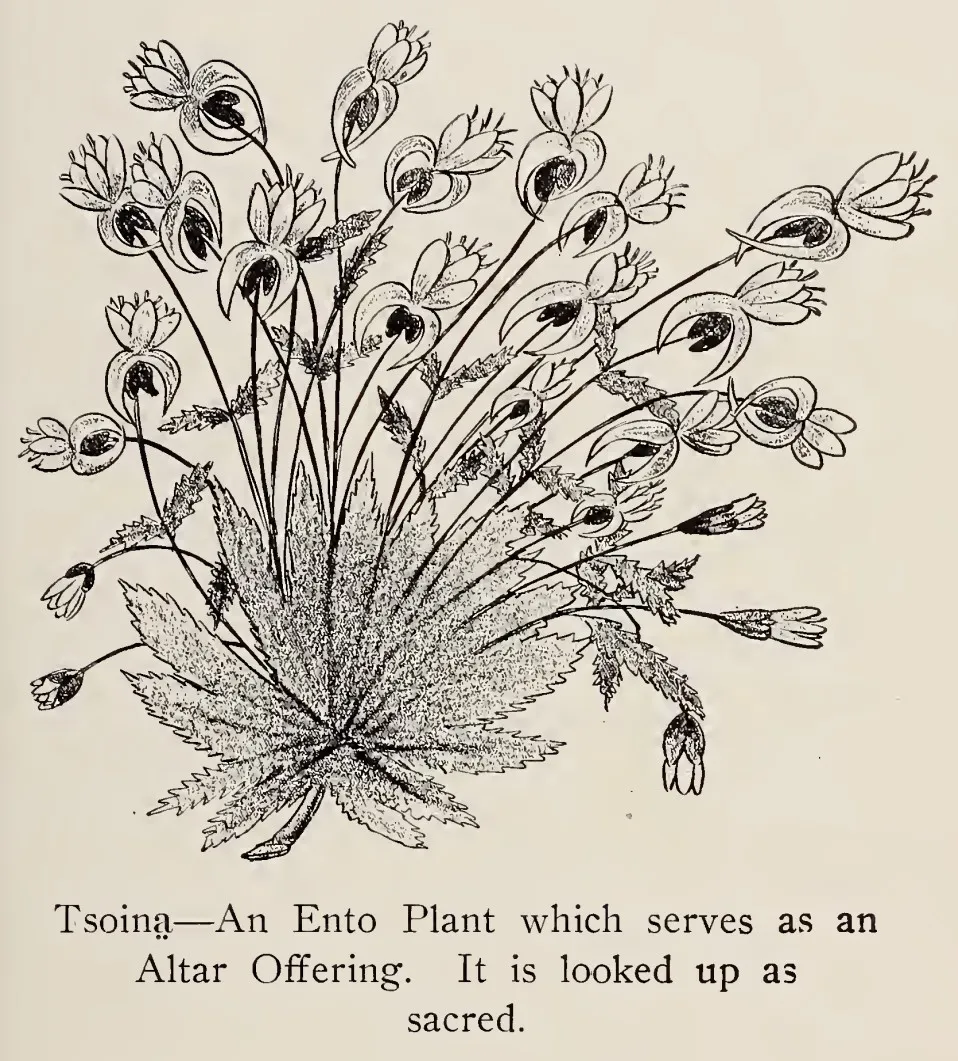
“‘The message was that henceforth only animals, grains, fruits and red and golden Tsoina̤ and Valseta̤ blooms, emblems of his abode, should be laid not as sacrifices, but as offerings of remembrance, upon his altars; that he desired that his children should grow purer in mind and heart, nobler in their lives, more loving and just in their conduct; for as they should deal one with another so would he deal with them; and that should he find them worthy of His mercy and beneficence, in some coming time he would vouchsafe a further revelation of His will towards the children of his love.’
“While Zeydon related this amazing, this overwhelming revelation I grew so tremulous, so confused in mind that I swayed to and fro and would have fallen to the floor had he not caught me in his arms; which so added to my agitated state that for a brief space I lost consciousness. And oh, the shame of it! the shame of it! As I regained my senses I felt his kisses on my lips, on my eyes and my face was wet with his tears. Through terror of him I again swooned, which so alarmed him that he summoned assistance. When I again became conscious I found myself in my own apartment with attendants ministering to me, and the anxious countenance of our kind physician, Ammen Elda, bending over me. To his questioning as to what had induced the seizure I could make no reply, and as he persisted in his inquiries I fell into such a fit of uncontrollable weeping that he refrained and sought for means to control my agitation, which seemed to greatly perplex him.
“Before departing for his residence, Zeydon made inquiry as to my condition; and I was made to understand that it was his opinion that “silence and solitude” would soon restore me to my usual state of tranquility and health.
“Ah, little does Zeydon, or any one but thee, my Inva̤loû, know of the tempest of angry rebellion that ever rages in my heart against him who is the cause of our cruel separation from our dear parents and our home, where we were as free and joyous as soaring Flicksha̤ (a beautiful gray and yellow singing bird) singing their morning song to the rising radiance of Andûmana̤’s glorious abode. And Inva̤loû, my Inva̤loû, I am so filled with apprehension and with a dread of I know not what that the knowledge of Andûmana̤’s wondrous revelation to his children falls almost without meaning upon my senses.”
During Frona̤’s impetuous relation of her astounding experience Inva̤loû seemed to have grown into the rigidity of a statue. Only that his breath came in short, labored gasps and that in his dark eyes was an expression of horror and amazement, one might have thought him bereft of life. From his close set lips came not one word to break his silence, which so alarmed the trembling Frona̤, that in great trepidation she clung to him, calling tenderly, tearfully, “Inva̤loû, Inva̤loû.”
Beyond a slight movement and a quivering sigh that was as a moan of some wounded creature, he made no response.
“Inva̤loû! My dearest, speak to me, oh speak to me!”
Frona̤’s entreating voice shocked him into partial consciousness. A rush of color dyed the rich olive of his face and then, arousing as from a stupor, his eyes rested tenderly upon the lovely golden head of her whose existence was so closely interwoven with his own. Then he drew her white arms upward about his neck and in a broken voice murmured: “My dear love, my poor love, it were better far that the flames of the sacrificial altar should burn thy fair body to ashes than that the flame of Zeydon’s unholy passion shall consume thy life and mine. Frona̤, Frona̤, how shall I save thee from this treacherous priest who tore us from our dear home, from our beloved and loving parents, from all that made existence desirable, that thus he might have thee at his mercy?
“That I was made to share thy misfortune, was not that he cared aught for my welfare, but he dared not accuse thy parents of a lack of religious observance, and proper care for thee without accusing mine of a like violation of the commandments of the sacred writings. Now the mystery of his conduct, which ever has perplexed me, is solved, and, though I die for it, he shall atone for the wrong he has done thee and me.
“Frona̤, my dearest, thou hast risked much in coming to me to-day and every moment increases the hazard of a discovery of our meeting, which must not soon again occur lest harm may come to thee and me. Here in this cleft of our rocky trysting place leave written word of any evil that may threaten thee, and I swear by the just gods that should Zeydon further pursue thee I will send him into the Silence, even though we both may follow him.”
For a moment her white scared face rested on his breast, and lips met lips tremulous with contending emotions; then there were tender, lingering adieus, and Frona̤ stole noiselessly away through the shrubbery, a lovely white robed vision with golden hair, shaming the sheen of the gold, a gemmed fillet confining it away from her brow from whence it fell in shining waves, framing a face as beautiful as the face of a goddess and veiling a form of surpassing perfection.
Motionless as the rock against which he leaned, but with face aflame and eyes full of tenderness and unshed tears, Inva̤loû gazed upon her retreating form until the last faint glimpse of her white robe vanished; then, with drooping head and drawn brow, he stood thinking; and as memory revived the sorrowful events of recent years the lines in his youthful face deepened into an expression of helpless, hopeless anguish, and his form was shaken by a tearless sobbing, pitiful beyond description. After a time this grievous paroxysm ceased, and into the depths of his dark eyes came a glow, as of hidden fire, irradiating his now upturned face, which in a few passing moments had grown so strangely mature and so startling in its intensity of expression that Inva̤loû Nyassa̤, the youth, stood revealed as Inva̤loû Nyassa̤, one of the handsomest and most noticeable men of the stately Wend race.
Upward, upward from the invisible realm of the Supreme One, Dia̤fon ēvoiha̤, had risen; and now it neared high noon, when Andûmana̤ would look downward from His glowing abode upon the homes of his children, from whence many were hastening towards his temples to offer to him their reverent adoration, and to the Deific Ones, his messengers, their supplications for forgiveness of transgressions or for protection from danger and the dread summoner, Death.
Presently the air became vibrant with the melody of temple bells, and the rapt expression of Inva̤loû’s face grew into one of intense entreaty as with upreaching hands he reverently prayed: “Oh thou Supreme, Self-existing One, in whom there is neither beginning or ending of time: thou lookest backward and forward and knowest all things. Thou who art all wisdom and all power and who createst and destroyest as it pleaseth thee; thou who knowest thy children, who know thee only as thou revealest, thyself to them; thou loving, just and merciful one to whom thy messengers bear records of the good and evil deeds of thy children, I, Inva̤loû Nyassa̤, implore thee that thou mayest permit thy messenger to bear to thee a plea for mercy for two of thy sorrowful children who desire to serve thee according to thy expressed commandments, and who fear thy righteous anger should we take upon ourselves vows for which a mutual love which has existed through all the years of our young lives unfits us. Pity us! Oh, pity and save us from an unwilling desecration of thy laws and of the ceremonials of thy holy temple! If my plea shall meet with thy disfavor then are we lost to all hope of rescue, and naught but the silence of death can save us from a darker doom.
“To thee, thou messenger divine, I commend this prayer to Andûmana̤. Plead for us, that if we may not escape from taking upon ourselves obligations which we dare not assume, that once, ere we shall go into the Silence, we may behold the dear faces of our beloved parents, who, if they yet exist, are full of sorrow and loneliness. I have naught to offer thee; but for thy loving service I entreat thee to accept the adoring gratitude of my breaking heart.”
For a little he stood as though listening for a response to his prayer; then, with a heavy sigh, he took up the book which had fallen from his hands and went hastily towards the Litzen Rinda̤ (institution for the training of priests and priestesses), to assist at the noonday service.