Chapter XIII: The Cloud’s Silver Lining
To facilitate a clearer understanding of certain features of this little story, it seems advisable that I shall offer such information as may render intelligible what otherwise may appear inconclusive.
Decimon Hûydas, the author of the story, was not a writer of fiction, but a noted mathematician; hence, his style lacks the continuity and conciseness of the trained literary writer. I might take the liberty of arranging the events and incidents of the story to suit my own ideas, but I prefer that my recital shall retain his quaint manner of expression. As he did not anticipate that “A Romance of Ento” might become known to the peoples of another planet, he confined himself to what concerned the peoples of his own world and time.
Inferentially, he conveys the information that in his time, corresponding, De L’Ester says, to your ninth century, travellers passed quickly from one locality to another. Naturally, queries may arise as to what manner of conveyance made this possible. Without entering into particulars as to the various means of transportation on our planet, I may say that long antecedent to your earliest historical records, both land and air transportation had with us become so perfected as to afford safe and speedy conveyance for all the requirements of travel and commerce. I also may state that with us wireless telegraphy has been in common use during many Ento centuries.
On our side of life it is well known that, in time, the humans of all planets of like conditions arrive at, or near, the same conclusions. How can it be otherwise, since in the human are all the infolded possibilities of infinite, intelligent creative force: and, given like, or similar, conditions, imperative, immutable law compels unfoldment in like, or similar directions. Thus it occurs that, Ento and Earth being much alike as to constitution and conditions, evolvement of both planets and all pertaining to them must proceed along similar lines.
It may not be amiss to say, that we are able to perceive that in the near future a man of your people will so perfect air transportation as to make it practicable; and that, ere long another inspired mind will astound your world with a discovery by which your fuel may be so cheaply procured from outside the earth, that your coal mining horrors will become an unpleasant memory of the past.
I now will resume the relation of “A Romance of Ento,” which, I doubt not, my auditors will feel inclined to pronounce a tragedy as well as a romance.
Genessano Allis Immo.
During the night succeeding the tempest, from all over the area devastated by its terrific energies, arose agonizing cries of distress of mind and body. In rural localities the destruction of life was remarkably great. Whole villages having been drawn within its vortex, were left shapeless ruins, amid which the dead, the dying, the injured and the grief-stricken and terrified survivors presented a ghastly and heart-rending spectacle.
Upon the southwestern and beyond the northeastern suburbs of the city, the tempest concentrated its utmost fury; so sudden was its coming that everyone was so overwhelmed with fear that they scarcely attempted to protect themselves.
It cannot be said that the residents of the city and surrounding villages were not forewarned as to the possible destructive energy of the approaching tempest, for indeed its course and velocity were duly signalled. But so swiftly had it swept over them that in a few awful moments it came and was gone, leaving in its pathway desolation unspeakable. To the survivors of the calamity it ever was a memory filled with grief and horror.
Ere the tempest had quite spent itself all Ento knew of the terrible disaster that had befallen their unfortunate brothers and sisters, and quickly air transports and Tuzamos (tramway carriages) were carrying to their assistance men and women skilled in the sciences of surgery and healing, and all that minds, hearts and generous means could offer was placed at the service of the sufferers, to whom that first night of dismay and sorrow was one continuous horror.
To Inva̤loû and Frona̤, that which had so suddenly, so unexpectedly, befallen them was as a half-waking dream. Only their physical pain seemed real. That in a short time they might be in the arms of their beloved parents was beyond their power of realization. But Frona̤’s case growing more and more alarming, and no immediate means being available for her relief, it became imperative to remove her at once to Koidassa̤. Under the influence of an opiate, which rendered her insensible to her condition, accompanied by Inva̤loû and other injured ones, she was quickly borne to the home of her childhood.
In the early dawn she slowly awakened to the consciousness that she was in her own room and lying upon the pretty couch she so well remembered. And oh! joy of joys supreme, over her bent the faces of her dear parents, and close by were Inva̤loû, his parents and Oûman Mitsa̤, on whose tear-swept countenances she read joy and love unutterable.
In presence of such a sacred scene, well might one’s eyes fall abashed. Only the just gods, who in their own inscrutable way had made it possible, could with tearless eyes have looked upon the marvelously strange reunion of parents and children, who through hopeless years had longed for each other as we all long for a sight of the faces and forms of our dear dead whom, alas, we know we shall see no more.
So great was the joy of once more beholding their dearest ones, that for the time neither Inva̤loû’s or Frona̤’s parents thought of what the future might bring to them and their children. It was enough to have recovered them if but for a day. By her parents even Frona̤’s serious injury was regarded as an immeasurable blessing, for had not it been the means through which their darling had been brought to their arms? Aye! to their arms which had so longed to embrace their beloved, their beauteous daughter, now grown and ripened into a womanhood of such exquisite and wonderful loveliness as to be incomparable—so incomparable, indeed, that one can find excuse for her fond father saying, “Damma̤, heart of my heart think me not foolish: but our child is so beautiful, so marvelously charming, that in my mind I find growing a sense of pity for Zeydon. Even a god might not gaze unmoved upon her matchless loveliness.”
And the proud and loving husband and father smiled fondly into his wife’s eyes as he said, “As the child is, so wert thou, my dearest one, when the gods gave thee to me.”
In both Koidassa̤ and Amâtûta̤, which yet are substantial and handsome residences, are portraits of Inva̤loû and Frona̤, painted about one year later than the period in which the tempest occurred. I question if on all Ento are two personalities surpassing in charm of feature and form the son and daughter of the Nyassa̤s.
Aside from the serious fracture of Frona̤’s limb it soon became apparent that she had received other alarming injuries, and for a time her condition was too precarious to admit of her being informed that Zeydon, also, was an inmate of Koidassa̤. At intervals faint tones of his delirious ravings reached her ears, but as she was aware that there were other sufferers in the spacious residence, the sounds were easily accounted for. Neither, at the time, was she informed that in one apartment death had noiselessly entered and had borne into the Silence a maiden novice who in the Litzen Rinda̤ had been her dearest friend and closest companion. Azēon, the god of love, never had touched the heart of this maiden, through whose unkissed lips the breath of her young life departed into nothingness; but her woman’s heart had read Invāloû’s and Frona̤’s secret, and she had guarded it as though it were her own. Loving hearts mourned over her dead body, and loving hands bore it tenderly away to receive the last sad service they could offer.
As assuredly it should be the influence of our holy religion dominates the thoughts and conduct of all right-minded persons. Being the highest expression of human advancement, naturally it should take precedence of the civil government, which, through various exigencies, must necessarily accommodate its functions to changed conditions. Not so our holy religion, which never changes.
It is true that since the establishment of its sacred doctrines and rites, Andûmana̤, in accordance with his will, from time to time hath, through his highest representatives, our most high priests, granted to his children special proofs of his boundless love for them: but our holy religion and its admirable ceremonials remain, and ever will remain, unchanged. With a full understanding of its demands, to Oûman Mitsa̤ and the Nyassa̤s, who were dutiful children of Andûmana̤ and devout observers of his Commandments, it did not occur to question the authority of its highest representative, the Most High Priest Moûkara̤. So between hope and fear the days passed, and they awaited the decision which for them meant life and immeasurable joy, or death and endless Silence.
All the avenues of information being open to the Most High Priest, he readily procured minutest information concerning the lives of the Nyassa̤s, which he found singularly blameless. Even their altar offerings had been munificent, and, wherever required, their generosity had been so unsparing as to be noticeable. As for their instruction of their children, it had ever been of a character to impress their young minds with most exalted views concerning religion and the ordinary duties of life. And among their numerous friends, indeed by all with whom they shared a mutual acquaintance, their children were considered models of fine conduct.
He also learned that, late in the afternoon of the memorable evening of Inva̤loû’s and Frona̤’s removal to Moûtsen ken a̤va̤, with positive instruction to return in time for the temple service, they had permitted the children to row on the lake. Unfortunately, they were a little belated, which afforded the High Priest Zeydon the color of an excuse for the separation from their parents. This and more of favorable import came to the most high priest’s knowledge, but until Tymonas, the wise and just god of the inner sanctuary of the Temple Zim, should declare Andûmana̤’s mind, Moûkara would not presume to speak concerning the disposition of their children.
Though I do not mean to unduly palliate Zeydon’s offense, while reading the faded record of his expiation I find myself somewhat resentful towards certain persons who, at the time it was made known, and since, have in a self-righteous manner commented upon his strange conduct. While one must admit that in his behavior towards the Nyassa̤s he did not do as he would have desired another to do by him, one must also admit that he was sorely tempted, else he never could have so dishonored, not only his vows of consecration, but his position as High Priest of Yaffa a lûytos.
It may be thought that I, who am so far advanced in years, should be less lenient and more critical in my estimation of the behavior of others. But as the passing days draw me nearer to the Silence I find myself looking backward to my youth, when I, too, loved one of Ento’s fairest and sweetest daughters. Until death stole her from my arms I so adored her, that in comparison with her all else was valueless. Though many years have gone since I was left in loneliness, even yet the memory of my beloved, lost Elza inclines my heart to sympathize with all who lose themselves in the mazes of the resistless passion: whose rewards are joy ineffable, or despair unfathomable.
I am far from being so presumptuous as to compare my characteristics with those of one so exalted as the Most High Priest Moûkara, who by sacred historians is mentioned as a man of extreme purity of mind and heart, and as one who ever tempered justice with mercy. But I readily understand, that in considering Zeydon’s case he would take into account, that though he had greatly sinned, he also had suffered much.
Of all that concerned Zeydon, Invāloû and Frona̤, he finally became fully aware; and as he considered the strange combination of circumstances which had brought to them such remarkable and almost fatal results he became strongly confirmed in the belief that, through Andûmana̤’s permission, the mighty gods are largely the arbiters of the affairs of men.
Immediately after the storm subsided the peoples of our beloved Ento became informed as to particulars concerning its lamentable destruction of life and property; of the High Priest Zeydon’s probably fatal injury and removal to Koidassa̤; of what had befallen Invāloû and Frona̤, and of their return to the home of their parents; of the partial destruction of the high priest’s residence; of the almost total demolition of Moûtsen ken a̤va̤, and of the distribution of the uninjured priests and novices among other Litzen Rinda̤s. From many sources came messages of sympathy and generous proffers of assistance.
Upon investigation, the temple residence was found in such a ruinous state as to require its entire reconstruction; and when at last the prematurely aged and broken Zeydon gazed upon the spacious and beautiful structure which, through the sympathy, piety and munificence of those under his charge, was nearing completion, his tearful eyes and quivering lips attested to his appreciation of the kindness of those whom formerly he had regarded as mere appendages to his sacred dignity.
Was ever man so changed as was this cold reserved priest Zeydon a̤ Gamala̤. This man whose life, up to a certain period, was so blameless that in his self-righteous view of himself he had felt himself above and apart from human sins, sympathies and sorrows.
But something had occurred. Ah, yes, something had occurred to dissipate into nothingness his former estimate of himself. Through unspeakable agony of body and anguish of mind he had learned the meaning of the vision of the sanctuary, and, praise be to the pitying and merciful gods, the radiant one, the better part of himself, had conquered. Away into the darkness of the sinful past, from which he turned with a shudder of horror and remorse, the monstrous being, his baser self, had fled; and with humble heart and faltering steps he for the first time since his protracted illness turned his footsteps towards the temple. Slowly, laboriously he ascended the great flight of steps leading up to the main entrance. Upon reaching it he turned and gazed upon scenes he had thought he might not again behold. Yonder, in the distance, the late afternoon Dia̤fon ēvoiha̤ touched, as with fiery fingers, the lofty domes and towers of Lēonita Tylû. Through the greenery of shrubs and trees he caught glimpses of the quiet, pretty lake upon which fronted the home of the Nyassa̤s, where, during his long illness, he had found shelter and such boundless hospitality as only persons of ample means and extreme kindness of heart could have bestowed.
And Frona̤ was there. But Frona̤ was dead to him; yes dead to him. He had put her away out of his life; she who never should have entered it. But the fault, the sin, was his own, and he had suffered for his sin. Oh! how he had suffered. But that he must forget: it should no longer torture him; he could endure no more; he would try to live that he might serve his people; he would make their joys his joys, their sorrows his sorrows; he would strive to make all possible reparation for his sin: and in time peace might return to his unhappy mind and heart.
Then his somber gaze wandered over the glowing myriad blooms of the temple garden and over the fountain groups, from whose parted lips or extended hands silvery jets shot upward to fall in showers of jeweled drops. Along one pathway memory led his brooding thoughts; and, as he recalled the strange vision that had come to him there he murmured: “Ever the memory of it clings to me, and ever my unquiet thoughts are asking, What if it may be true? Perchance Andûmana̤, the All Wise, conceals from his children a truth that might unfit them for their present existence. But I am naught but a dreamer, and the land of my glorious vision was a land of dreams, as unsubstantial as the fabric of cloud shadows, or the memories of dead faces of our vanished loved ones. And ere long I shall be but a memory to—whom? Alas, to no one but to those who will think of me as of one who never gave sign of love or sympathy for others.”
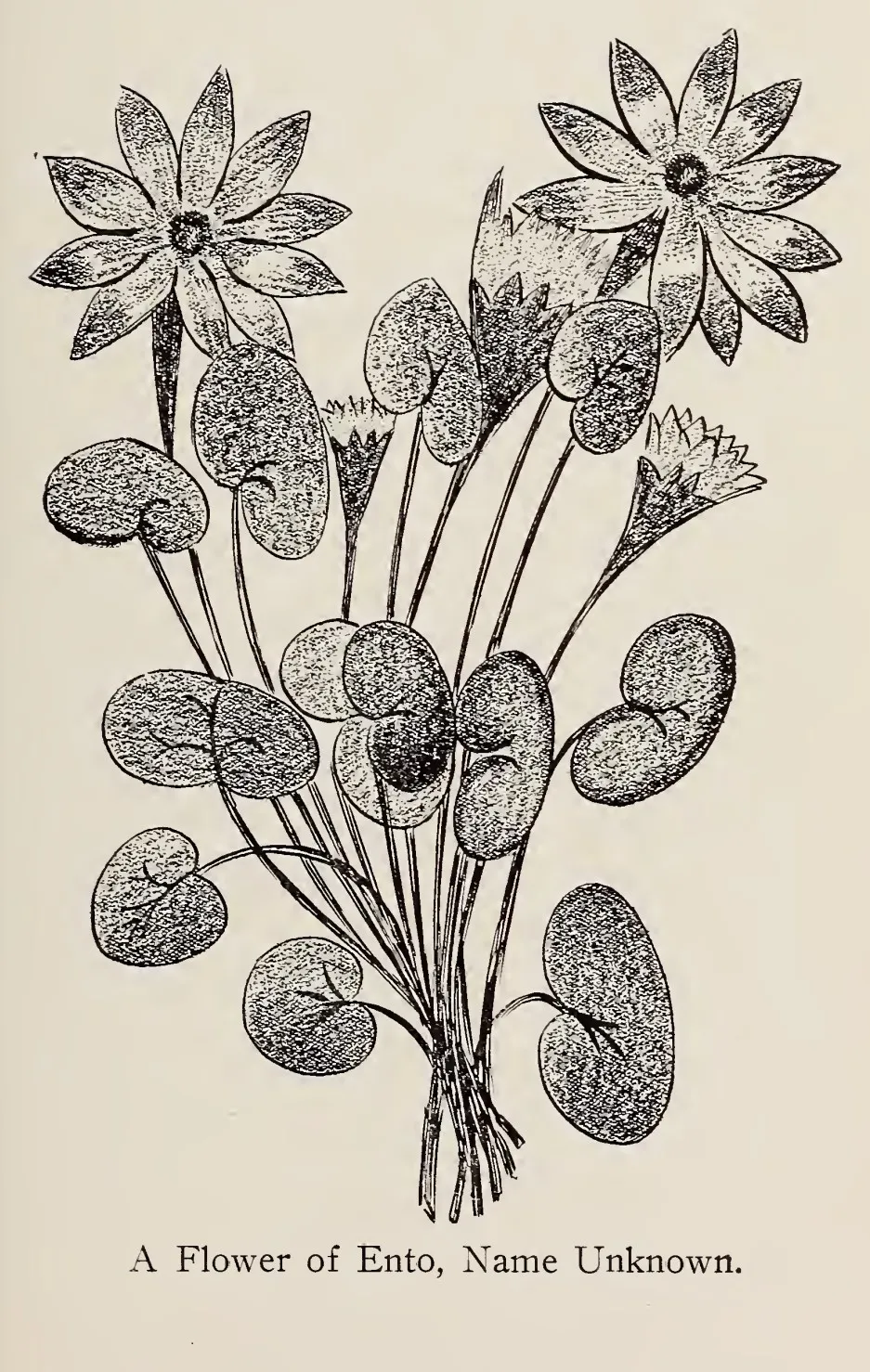
Then with humbled heart and faltering steps he turned and entered the quiet temple, where for a little while he glanced at the restored altar and crystal Dia̤fon ēvoiha̤, irradiated by paling beams: Andûmana̤’s disappearing abode. At length he moved toward the inner sanctuary, drew aside the heavy drapery and once again stood before the glowing emblem of the dwelling place of the Creator of all things. Sinking to his knees, he drew the skirt of his robe across his face, and, for a time, naught but his faint breathing broke the stillness. Then in broken, tremulous tones he cried: “Oh Soima̤, Soima̤, thou ever constant one, who when Death would have borne me into the Silence, entreated that I might be spared to make reparation for my sinful conduct, my inexcusable wickedness: I implore thee, Soima̤, to bear to Andûmana̤ my humble entreaty for the pardon of my shameful violation of my vows of consecration. Plead for me, Soima̤, as thou wouldst plead for thyself wert thou a sinful man, fallen through weakly yielding to the mad passions of human nature! Plead for me, that the Deific Ones may give me strength to grow pure in heart and so humble in mind that I may be as dust under the feet of those whom I have so grievously wronged. And thus may I, ere I shall go into the Silence, obtain peace of mind and ease of my heavy, aching heart.”
Gentola̤ ēmana̤: Ere Genessano resumes the recital of a Romance of Ento, which nears its conclusion, I desire to say that its chief purpose is to present to those who may read it some glimpses of the social and religious life of peoples known to earth’s dwellers as Marsians, but who know themselves as Entoans, which in their language signifies “chosen” or “set apart.”
We are aware that against the sombrous coloring of the story, the tastes of some persons may revolt, but to those who seek for truth under whatsoever guise it may present itself, the end in view may incline them to a favorable consideration of the means we are constrained to use, in order that we may convey a correct, though very circumscribed presentation of certain features pertaining to peoples so like those of our own planet as to offer no radical differences.
The events of the story preceded, by about one Ento century, Genessano’s departure into Ento’s spirit realms, which occurred during our tenth century: yet you and we have had opportunity of observing that the Entoans, after the lapse of several centuries, have not as a whole, progressed very noticeably.
It is a truth, that the progress of what is termed civilization when applied to the entire peoples of any planet is by nearly imperceptible degrees. The advancement all along the line of human endeavor is never simultaneous. Yet no individual or collective movement is ever lost: it remains an added force to the sum total of evolvement, whose activities are unceasing and unerring.
No other inhabited planet of our solar system presents, in all directions, correspondences so noticeable as those which exist between Ento and Earth; and were I a prophet, or the son of a prophet, I would predict, that ere the close of the present century communication, on a scientific spirit basis, will be established between the two worlds known, astronomically, as Earth and Mars.
Why do I make this statement? For the reason that we on the spirit side are aware that there are forces at work which are making the ways straight for inspired ones who are coming to perceive that, back of material science, there is a spirit science which is to material science what substance is to its shadow. And when this truth shall have become fully recognized, as ere long it will be, communication between the physically disembodied peoples of two closely related worlds and their mortal brethren will become so clearly established as to be of common occurrence.
CARL DE L’ESTER, Guide and Interpreter.
Autumn deepened into Winter, and Winter merged into Spring, through whose wooing all nature burst into buds, blooms and up-springing verdure, clothing the face of the land as with a silken carpet. Ere long Spring with outreaching hands and smiling, perfumed lips welcomed her royal successor, glowing Summer, the Queen of all the Seasons, who brought in her gorgeous train a bounteous harvest of grains and delicious fruits for the sustenance of Andûmana̤’s children.
Throughout the area of the storm swept localities busy hands had been, and were yet, engaged in the restoration of wrecked homes and other structures; and now, though less than a year had elapsed, only suggestions of the havoc of the tempest remained to mark its devastating course. But during this lapse of time, in the affairs of those of whom I write, notable changes had occurred. Through terror and physical injury, Frona̤ barely escaped from passing into the Silence. Finally, through most scientific treatment and careful, loving attention, she began to revive, and, now in early Summer she was strong enough to listen, for the first time, to a recital of all concerning the tempest and its consequences.
For some time she had known that the high priest was an inmate of Koidassa̤, but only now did she learn of what had occasioned his presence there, and that, although he had been made acquainted with the disastrous effects of the tempest, and that she and Inva̤loû also were at Koidassa̤, he had expressed but slight interest concerning affairs pertaining to himself and no desire to see either of them. Thus although for many months they had been sheltered under the same roof, he and his charges had not confronted each other.
During all this wearing, anxious time, Oûman Mitsa̤ was not idle. Through repeated visits to the Most High Priest Moûkara he had made the true state of the Nyassa̤s’ affairs so clear to His Sacredness’ mind that it only remained that Zeydon should have a hearing, before appealing to the great God Tymonas, of the inner sanctuary, concerning Andûmana̤’s will towards Inva̤loû and Frona̤. But as yet this must be delayed until Zeydon should be sufficiently recovered to journey to Da̤o.
By detailing the various events of the daily lives of the Nyassa̤s and others concerned in this story, we might, were we so inclined, greatly lengthen the number of its pages. But heart aches are ever plentiful, and I doubt the taste and judgment of a narrator who seeks to multiply or color occurrences beyond the bounds of either propriety or probability, or to wound the sensibilities of those whose kindly emotions ever respond to all that appeals to gentle natures. So, upon the events and scenes preceding the closing of my narrative, I shall touch but briefly.
It is quite reasonable to suppose that only those, into whose charge Andûmana̤ has given his children, can understand the peculiar intensity of parental love, to which nature sets no bounds. In the case of the Nyassa̤s, the tragic events of recent years so exalted and intensified their love for their children that they counted all else as of small value. As from day to day they observed the spontaneous expressions of affection between the two young, guileless creatures, Invāloû and Frona̤, their minds and hearts were filled with anxiety and dread of what the near future might hold in store for them. As yet, they had received no assurance that their children would be released from either the custody of Zeydon or the claims of the Anatûzza Fûndoitsa̤. The utmost that Moûkara would say was, “Wait. Zeydon must first be heard, then, as Andûmana̤ may decree, so must it be.”
To the youthful, buoyant minds of Inva̤loû and Frona̤ the past was fading into oblivion. They had each other; they were within the shelter of their dear home and the arms of their adored and adoring parents. Surely, surely the sorrowful past would not repeat itself; the days and nights of dread and terror would return no more: and they smiled into each other’s eyes and murmured words of love and were content. The days fled on wings of fear, and under their breath the parents questioned each, “What shall we do, if the most high priest may not save them and us? What shall we do?” Though their lips made no reply in the sternly set faces of Lûvon and Damma̤ and the tearful eyes of Tillēne and Avānna̤ each read a reply that stilled their heart beats. “Yes, yes,” they said, “there is but one way; and if needs be we all will walk it together.” Then to their happy children they gave smile for smile and from their anxious, heavy hearts they spoke to them words of cheer. The days fled away, and they waited, waited, waited.
Towards mid-afternoon of a warm, windless day, in the family of the Nyassa̤s quite a notable event occurred. Frona̤, who for so long had laid at the parting ways of life and death, had at last so far recovered as to express a desire to sit under the shade of the Bûdas trees, as so long, long ago she and Invāloû had sat, listening to the wind in their great rustling branches—the wind that to their childish fancies had seemed to whisper or sigh wonderful meanings of strange and mysterious things they never could comprehend. And now her frail, trembling form, encircled by Invāloû’s strong, protecting arm, appears at the open doorway, and as through her weakness she timidly, hesitatingly shrinks from attempting to descend the flight of steps leading downward to the lawn, Invāloû, against her shy protest, takes her into his arms and carefully bears her down to its green velvety sward, where she stands with the air of one attempting to recall some half-forgotten memory.
Suddenly her eyes seek the white stone landing by the lake shore and, with the glee of a child, she cries, “O Inva̤loû, my Inva̤loû, I wonder if the broken oar is yet hidden under the landing steps?” With the impetuosity of youth Inva̤loû rushes off towards the landing, disappearing for a moment among some shrubbery. Presently, with less buoyant steps and holding aloft two pieces of a broken oar, he returns to the expectant group of Frona̤ and their parents, who now were seated under the Bûdas trees. “There, Frona̤ dear,” he says, “is a memento of bygone days which afforded Zeydon an excuse to force upon you and me years of unspeakable sorrow and what is more to be deplored, years of grief and despair upon these, our dearly beloved parents. Say now, heart of my heart, how shall we dispose of this reminder of the saddest event of all our lives?”
Taking from Inva̤loû’s hands the broken oar, she for a while regarded it in silence. Slowly a vivid blush overspread her fair young face and, with charming shyness, she smiled into Inva̤loû’s eyes, asking, “Dost thou recall what occasioned the breaking of the oar?”
Now the hot blood surged into Inva̤loû’s dark face, as with mirthful confusion he replied, “Yes, I do indeed recall the occasion of its breaking.”
Turning to his and Frona̤’s parents, he explained that on the never to be forgotten afternoon of his and Frona̤’s boat ride on the lake they suddenly realized that Dia̤fon ēvoiha̤ was touching the horizon and that they were quite a distance from the landing; that Frona̤, more thoughtful than he, besought him to hasten, lest they might be late for the temple service; that, being in a mischievous mood, he suggested that as a reward for his exertion she should give him a kiss, which she was not inclined to bestow; that with assumed indifference as to when they might reach the landing, he rowed with such exasperating tardiness that Frona̤ petulantly declared her intention to hereafter boat by herself; that in boyish resentment, he suddenly began to row with such impetuosity that one of the oars snapped in twain and—“Well,” he said, “for the consequences of my thoughtless folly, which has so nearly wrecked all our lives, I cannot hope to ever atone.”
Exclamations of loving condolence burst from all lips, for all well knew that he had meant no wrong, and that his boyish prank had been made to serve another’s purpose.
Still Frona̤ held in her hands the broken oar, and as Inva̤loû concluded his recital of an occurrence, which until now was but partly known to any but himself and her, with paling color and in a voice tremulous with emotion she said, “Heart of my heart, if it may please the just and merciful gods to incline the Most High Priest Moûkara’s mind to release us from the High Priest Zeydon’s custody our two lives, like the two halves of this broken oar, may become united. If such a happy conclusion of the sorrow which has so darkened the lives of these beloved ones and our own may arrive, we will with a jewelled band unite these fragments and over our home altar the oar shall be placed as a reminder that hasty speech and inconsiderate actions ever lead to occasions for repentance.”
With smiles, tears and caresses her auditors gave unanimous expressions of their approval of her decision.
Through an open window Zeydon, who still was an inmate of the home of the Nyassa̤s, looked with startled gaze upon the group under the Bûdas trees. Not since the memorable interview between Frona̤, Oûman Mitsa̤ and himself had he beheld the face of the innocent cause of his lamentable departure from the path of rectitude and honor. Now as his sunken, somber eyes rested upon her pallid face and emaciated form, such a wave of self-accusation swept over him that he covered his haggard face with his hands, moaning, “Oh Andûmana̤, canst thou forgive thy wretched and repentant son? In deepest humility I implore thee for strength that I may make atonement to these wronged ones, whose generous kindness fills my heart with such bitter self-accusation that I sink under the burthen of my shame and guilt.”
For a time hot tears of regret and remorse streamed from his eyes, and when at last he raised his head the Nyassa̤s were returning to the house. Lûvon and Tillène, Damma̤ and Avānna̤ watched with anxious interest Inva̤loû’s attempt to sustain Frona̤’s feeble, halting steps; and as Zeydon eagerly scanned her wan, but supremely beautiful face, his ears caught the words, “Nay, my Inva̤loû, thy solicitude exaggerates the gravity of my injury. I may yet grow well and strong: but should I not, thou wilt love me still.” In Inva̤loû’s tender, earnest eyes she found assurance of lifelong constancy.
As one stiffening in death, so stiffened Zeydon’s form, as he arose to his full height and staggered away from the window. For a brief time his radiant, his better self battled with the dark personality, and in his heart raged all the base emotions of jealousy, hatred and revenge. “This,” he muttered through set lips, “was why Frona̤ has ever repulsed my slightest attention. This was why she shrank from me as from some pestilent thing. Fool, fool that I have been to squander upon a shadow the substantial peace and contentment of a clean conscience, the exalted honor of unstained priestly vows!”
With an understanding of the situation came despair so overwhelming as to approach madness. Back and forth, back and forth the frenzied man swiftly paced the length of his spacious apartments, his illness, his weakness forgotten while struggling with the fierce tempest of human passions, which threatened to wreck both his reason and existence.
Those unfortunates who have endured the torments of unrequited love may, to a degree, comprehend the state of Zeydon’s mind, but only to a degree; for, aside from other torturing emotions, remorse, like a famished animal, gnawed at his heart and lapped his very life blood.
Surely the agony of that hour must have appealed to the pity of the merciful gods, for as he walked into his seething brain came a sense of dullness, of apathy. At last outraged nature could endure no more and in utter exhaustion, he staggered to his couch and fell upon it in a deathlike swoon, where later his faithful attendant Vanetta, found him and, with cries of alarm, quickly brought succor to the senseless man. Gradually, as restoratives brought him back to a state of consciousness, memory revived, and with it came a sense of helplessness and bewilderment. Until far into the night his thoughts were as Autumn leaves drifting before the wind. Nothing, save a nameless burthen which was crushing his heart, seemed real. “What is it? What is it?” he wearily asked himself. Suddenly he felt himself emerging from this vague mental condition into one of distinct consciousness and clear realization concerning his duty to himself and to others. In deepest humiliation he also realized that he could no longer lean upon his own strength, which was as a broken staff whose fragments pierced his weary hands.
But what should he do? To what source should he turn for strength to sustain his lamentable weakness? To Soima̤, the God of the Temple Sanctuary, he dared not appeal, for Soima̤ had shown him the danger which threatened him and the way of escape. But he had trusted to his own strength, he had stubbornly, blindly gone his own way, and now again he had fallen under the influence of his baser self, whom he loathed and shrank from, but from whom he found he could not, unaided, free himself.
In the adjoining room a night light dimly burned and at intervals an attendant, with noiseless footsteps, stole to his side to administer to his needs. The night wore on, and slowly into Zeydon’s mind grew a resolve that he would go to the Most High Priest Moûkara, and to him he would reveal all his sinning, all his suffering, all his futile struggling against that which he could no longer combat. As to the result he scarcely gave a thought: for what could matter any more? Nothing.
Wearied and worn beyond expression, he at last fell into a slumber, so profound that the gray of earliest dawn was heralding the rising of Andûmana̤’s glorious abode ere he stirred uneasily and softly called “Vanetta, Vanetta thou faithful one. Thou mayst now retire for needed rest. But at mid-forenoon we will take passage for Da̤o.”
Fearing that the mind of the high priest was again wandering, Vanetta was quickly by his side, but Zeydon’s quiet manner and faintly smiling lips reassured him, and after receiving further instruction as to the contemplated journey he summoned another attendant and retired.