Chapter XIV: The Priest’s Confession
Now we will recur to the period immediately succeeding the occurrence of the tempest. During all the days and nights of Zeydon’s dangerous illness Oûman Mitsa̤ was almost constantly by his side. Through listening to his fevered ravings he came into a clear understanding of the motives which had impelled the unfortunate priest to a course of conduct quite at variance with his calling,—and indeed at variance with his naturally honorable and elevated ideas of right. He learned how the rigid asceticism of the priest had so repressed his naturally fervid nature that when Frona̤’s exceeding beauty and wondrously charming personality awakened in him the emotion of love, his self-deception led him to attribute his interest in her to a higher motive than a selfish desire to have her ever near him. He learned that through all the years of Zeydon’s infatuation his passion for his victim was of such an exalted nature that her name on his lips was as though it were the name of a goddess. In Oûman Mitsa̤’s mind this strange passage in the life of the austere priest excited a sense of compassion, for truly he was only a little less a victim of the force of irresistible circumstances than were Inva̤loû and Frona̤. Though he did not at any time hold Zeydon wholly blameless he came to understand that, in an endeavor to compass certain ends, one may unconsciously grow so mentally and morally blind as to be irresponsible.
Throughout his protracted delirium Zeydon did not recognize even those most familiar to him; thus Oûman Mitsa̤, who so carefully watched the stricken man upon whose recovery depended gravest issues, came and went unnoticed by his staring, unseeing eyes. He and the Nyassa̤s well knew, that should Zeydon pass into the Silence the future of Inva̤loû and Frona̤ would depend upon the decision of an ecclesiastical court, over which the Most High Priest Moûkara presided. But should Zeydon recover and relent in his purpose towards them, and Oûman Mitsa̤ felt confident that he would relent, then their release through the potent influence of the Most High Priest might be accomplished. Daily, during this trying period, he was in communication with Moûkara, whose interest in the peculiar situation at Koidassa̤ constantly increased, but as yet no steps could be taken to change it.
As all things, both good and evil, in time come to a conclusion, so at last came a time which brought the blessed assurance that Frona̤ would continue to live. A little later Zeydon, who for a day and night had lain almost pulseless and breathless, opened his eyes to see bending over him Ento’s most famous physician, and the man of all men whom he most feared and disliked, holding a cordial, which he tenderly and gently pressed the nearly lifeless Zeydon to drink. Too feeble in mind and body to resist or more than dimly to recognize him whom he regarded as his most hostile enemy, he drank the proffered cordial and immediately passed into a long, restful slumber. When he awakened it was to find Frona̤’s still lovely mother by the side of his couch.
With gentlest, kindliest speech she expressed her pleasure that he had not passed into the Silence and her hope that ere long he might recover health and strength. Then she arranged his pillows, readjusted his couch covering, bathed his wan face, smoothed his disordered hair and, with the cheering, comforting manner of a mother towards a sick child, quieted his agitated mind and induced him to partake of some nourishment. After this he again slept, and when, between midnight and dawn, he aroused to consciousness, he heard an unfamiliar voice say, “Yes, he will, thanks to your unremitting attention more than to my skill, recover.” Then another and well remembered voice in most fervent tones murmured, “The merciful gods be praised.” Through his slightly unclosed eyelids he saw in the adjoining room Oûman Mitsa̤ and a stately man of middle age, clothed in the garb of a physician.
As to the high priest’s reflections at this period and throughout his tedious convalescence we need not be uncertain, for in the record to which I have alluded he wrote much concerning this feature of his lamentable experience. His mind always seems to have been filled with wonder and gratitude over the boundless care and attention he received at the hands of Oûman Mitsa̤ and the Nyassa̤s. In deepest abasement he wrote, “Oh miserable man that I am. Through shame and remorse I almost perish. For my cruelty, I have from these wronged ones received immeasurable kindness. But for their incessant care and matchless generosity I would now be in the Silence. How shall I undo my iniquitous conduct for which I have no righteous excuse to offer? O ye Deific Ones, who behold the follies and offenses of sinful men, aid me, I implore you that I may to the utmost of my ability, make amends for the years of grievous sorrow I have through wilful wickedness occasioned them.”
Much more of the same import is contained in Zeydon’s confessions, which indeed afford a complete analysis of his character and emotions; and, in so far as I am informed, no one ever has so entirely laid bare every thought and impulse of mind and heart as did this repentant priest, who, in concluding his memoir, wrote, “In deeper anguish of mind and heart than I can express, I write these lines hoping that they may serve as a warning to some weak man, who, after I shall have gone into the Silence, may, as I did unwarily yield to temptation.”
I fear that my digressions may somewhat confuse the minds of those who may read this story: yet I must test your forbearance further while, in my uncertain way, I go towards its conclusion.
Oûman Mitsa̤, who by the mid-forenoon air transport journeyed to Da̤o, was greatly surprised and somewhat disconcerted to observe that Zeydon and his attendant Vanetta also were passengers. With gentle courtesy he approached the high priest inquiring as to his health and expressing a hope that his Sacredness might speedily recover his accustomed vigor. Zeydon with equal kindliness of manner made suitable replies, but despite his evident attempt to appear composed his demeanor bespoke a mind ill at ease.
Oûman Mitsa̤, who was a man of extreme delicacy of mind and manner, having begged the high priest to command his service should he require it, retired to the outer promenade, where he occupied himself in pacing back and forth, his mind full of perplexity as to why Zeydon should so suddenly and secretly journey to Da̤o.
At near high noon the transport alighted at the station, and Oûman Mitsa̤ hastened to the Most Sacred Temple Zim, hoping to find opportunity for speech with the most high priest ere he should receive Zeydon, who he surmised had come to Da̤o for an interview with him. At the conclusion of the high noon service he approached the most high priest and earnestly besought him to grant him an immediate interview, which his Sacredness graciously promised, naming for the purpose the earliest possible hour.
At mid-afternoon he presented himself at the residence of the most high priest and was at once admitted to a private audience with his Sacredness, from whom he received a most friendly and affectionate welcome. Their greetings being concluded with an encouraging smile Moûkara inquired, “To what friendly wind am I indebted for having blown my dear kinsman in my direction? Is it that you would discuss some weighty matter concerning the government or perchance some interest of our holy religion? Or is it that you would speak of your unhappy relatives the Nyassa̤s that I am favored with your ever welcome presence?”
No further urging was necessary to induce Oûman Mitsa̤ to lay before the most high priest the sum of the information he had acquired concerning the high priest and the Nyassa̤s. As he related the substance of Zeydon’s delirious ravings through which he had learned the story of his temptation and his wrongdoing, which had resulted in years of utter misery to the Nyassa̤s, and finally in Inva̤loû’s and Frona̤’s narrow escape from death, he became so indignantly eloquent that Moûkara’s usually tranquil manner grew quite disturbed. But as the relation of events proceeded, gradually leading to an explanation of Zeydon’s reprehensible conduct and his present pitiable state Moûkara threw up his hands exclaiming: “My dear Oûman, you so bewilder me that I find it difficult to determine as to who is the more to be commiserated—Zeydon, or the Nyassa̤s. Truly, thy heart is so generous that I fear it sets thy judgment at fault.” And he smiled indulgently.
For a moment Oûman Mitsa̤ showed some confusion, then with an apologetic air he said, “I beg that Your Sacredness will bear with me for I confess that of late my experiences have so put out of joint all my ideas of right and wrong that scarcely can I determine which is the more to be pitied—Zeydon or the Nyassa̤s.”
At this moment the silvery trill of a tiny bell notified the most high priest that some one desired admission. In response to his signalled reply, an attendant entered, bearing to His Sacredness a folded paper which, with a repressed exclamation he read. Then, turning to Oûman Mitsa̤, he said: “You will retire to the adjoining apartment. One to whom I shall accord immediate audience awaits permission to enter.” With a peculiar smile lighting up his fine face, in a low tone he said, “May the Deific Ones inspire me with wisdom, for Zeydon approaches. You will await my summons.” And as Oûman Mitsa̤ hastily disappeared the High Priest Zeydon entered.
Yes, it was Zeydon, but Zeydon so changed in appearance and bearing that for a moment Moûkara gazed upon him in mute surprise. As with bowed head and halting steps the trembling priest drew near and knelt at Moûkara’s feet, he presented so piteous a spectacle that touched with profound compassion the most high priest stooped to raise him from his humble position. But with gentle resistance Zeydon put away his hands, crying in broken, tremulous tones: “I am unworthy to even kneel at thy feet. I am too impure for thy clean hands to touch me. Against Andûmana̤ and the Deific Ones I have sinned I fear past forgiveness. I am a most wretched and guilty man, and am no longer entitled to serve in the temple of Andûmana̤, the Most High, Sinless One, Most Sacred One. I have not come to thee hoping for or desiring pity or favor for myself: for I have so sinned against my vows of consecration that I dare not hope for pity or forgiveness from either gods or men. I have come to thy Most Sacred Sacredness to lay bare before thee my breaking heart and, if possible, to undo a most grievous wrong which I have committed. Have I thy permission for further speech?”
While Zeydon spoke into the Most High Priest’s face a strange expression had grown, an expression as fixed as that of a statue, as exalted as that of a god.
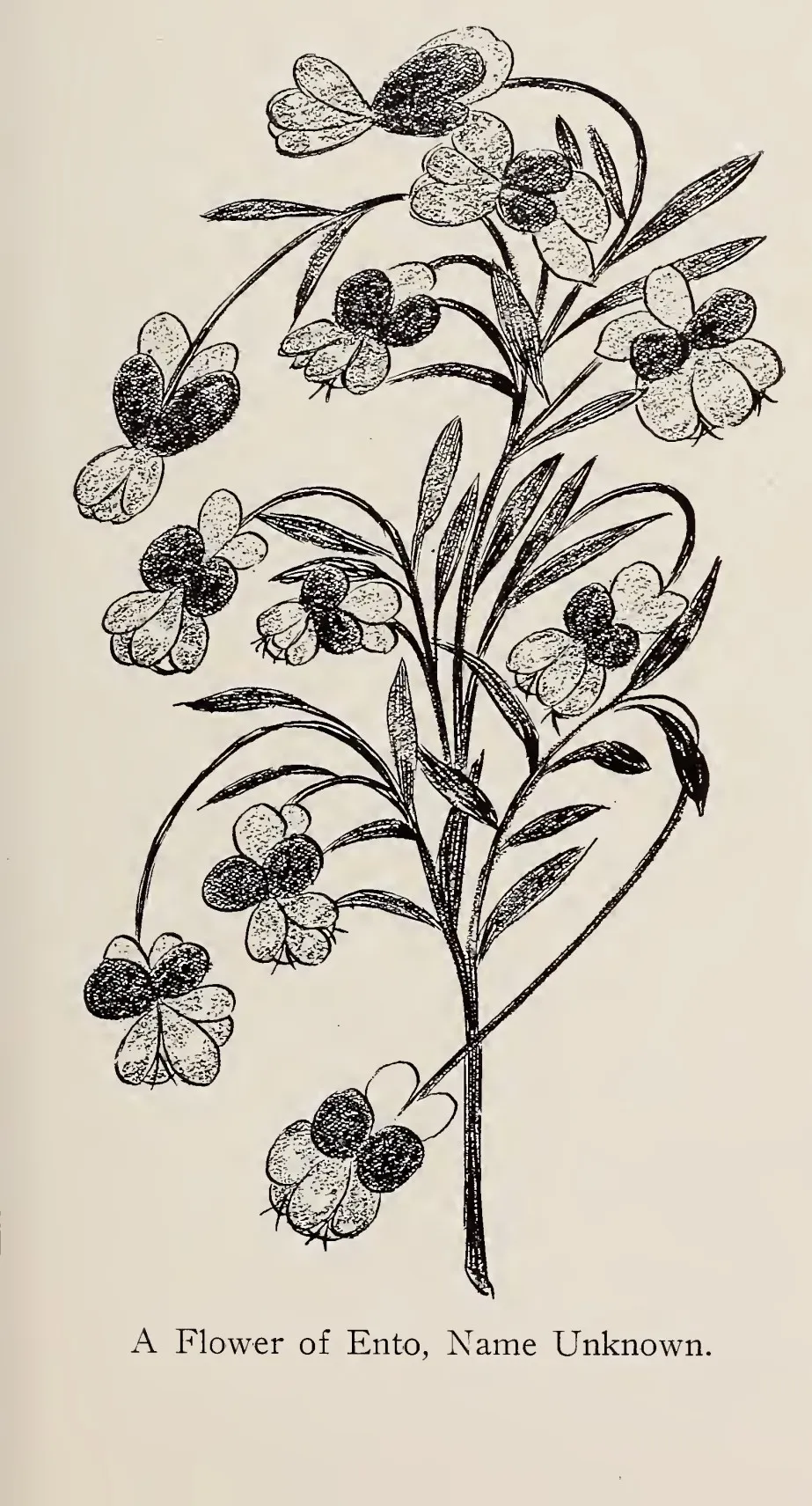
In my attempt to describe Zeydon’s interview with the Most High Priest, I am aware that I am encroaching upon forbidden ground, and also, I confess, I am drawing slightly upon natural inferences. At the same time, after having read the record of Zeydon’s expiation, including his interview with the Most High Priest Moûkara̤, I feel that I might find justification for saying much more than I shall trust myself to express.
With bowed head the suppliant high priest awaited permission for further speech, but as the Most High Priest neither moved or uttered a word, Zeydon slowly raised his head and in amazement gazed upon a face that was, indeed, as the face of a god.
With head thrown slightly backward and his large, dark, wide-open eyes gazing upward with an intensity that seemed as though they might pierce the very walls of Astranola̤ Moûkara̤, in a listening attitude, for a time remained motionless. Suddenly a rush of color suffused his dark face, and with a slight start he aroused from his intense reverie. Turning toward Zeydon, in gentlest tones he said:
“Speak, thou bruised and broken child of the One who created thee, as He creates all His children—imperfect—that through trials and much suffering they may grow strong in all the virtues, and thus may learn to love one another.”
Then Zeydon, in utter self-abasement, told to Moûkara the story of his life. How with the high enthusiasm of youth he had served his novitiate. How through a misconception of the finer meanings of our holy religion he had grown arrogant, unsympathetic and intolerant: regarding the priesthood as the embodiment, not only of sacred authority, but as possessing the absolute right to control the affairs of those under their charge. How through his life of rigid adherence to the beliefs and rites of what he had conceived as the true expression of our holy religion, he had grown so self-righteous that he had thought himself beyond the touch of human emotions and frailties. That, while regarding himself as invulnerable to the weaknesses of many men suddenly and, strange to say, unconsciously, he had fallen from the calm of an emotionless existence to the depths of an unreasoning passion for a young girl, whose innocence, wondrous beauty and singular charm of manner led all hearts captive.
Without the slightest attempt to palliate his wrongdoing, he laid bare to the most high priest an account of his struggles against the irresistible passion, which had held him in such complete subjection, that he possessed no strength of will to even attempt to release himself from a course of conduct that he fully realized was utterly ruinous. Of his remorse and wretchedness of mind he spoke with shrinking horror, and, at the conclusion of his tragic recital, which included his injury and long illness, and Frona̤’s injury and narrow escape from death, in tones of indescribable anguish, he brokenly said:
“Most Sacred Sacredness, I have laid bare before you my mind and heart. I have withheld nothing concerning my shameful disregard of the duties of our holy religion, or of my treachery toward those entrusted to my care. I deserve no mercy. I desire none. I have sinned: let my expiation be swift and in accordance with my deserts.” And, with his face buried in his hands, he awaited his sentence.
Bending over the crouching, trembling man Moûkara drew his hands away from his tear-stained, haggard face, saying softly, tenderly:
“Arise my brother. Thou hast indeed deeply sinned and thou hast also deeply suffered. Through thy sinning and thy suffering thou hast learned a lesson, which will fit thee for an understanding of the sins and sorrows of others. The fittest expiation thou canst make to Andûmana̤ and the Deific Ones, and to those whom thou hast so wronged, is to return to and serve faithfully those who have so long been under thy charge. As thou art one of Andûmana̤’s children, so are they children of the same creative power. Thus, are they thy brothers and thy sisters, who have a right to claim protection from thee.
“The wrongs thou hast committed against the Nyassa̤s thou canst not undo, but thou canst undo the wrongs that have found lodgment in thy own mind and heart, and in righting the wrongs of thy own nature thou wilt find means of atonement for the sufferings thou hast occasioned others.
“Thou sayst that thy passion for the Daughter of the Nyassa̤s hath burned thy heart to ashes. Let no mischance enkindle them. Thou art not the first priest, and alas, thou art not the last who, through weakness rather than through deliberate willfulness hath suffered, will suffer and cause others to suffer for unrighteous conduct.
“As Andûmana̤ hath signified that He desires in His Temples no unwilling servitors, let the children of the Nyassa̤s be, as thou desirest, released from their novitiate. And, as through the disastrous consequences of the tempest they already are with their parents, let them remain with them.
“Nay, my brother, say no more. Thou owest me no thanks. As thou knowest it is not I who judge thee, but those who not only read the words of thy lips, but the thoughts back of thy words. And if Andûmana̤ and His Messengers, the Deific Ones can, because thou art possessed of human and not of godlike attributes, forgive thee, it would illy become me who am but thy elder brother to deal with thee harshly. Ere thou shalt go into the Silence thou mayst find ample occasions for making to the Deific Ones and to those in thy charge atonement for thy offenses. Let thy love for all living things equal thy former indifference; for remember, that He Who hath created thee hath also out of himself created all that is: and thus thy love is as fully due the created as the Creator. Be to thy people the embodiment of all that is loving, just, kind, merciful and true. Open thy mind and heart to thy sanctuary god Soima̤, whom I know of as one able and willing to guide thee to righteous ends. Guard thy thoughts, acts and words that henceforth thy life may be as blameless in thine own eyes as thou wouldst have it appear to gods and men. Thus with thy mind and heart purified as by fire, thou shalt ere going into the Silence arrive at peace with the Deific Ones and with thyself.”
He ceased, and Zeydon endeavored to speak, but his agitation so overwhelmed him that he could only brokenly murmur: “May the Deific Ones do to thee as thou hast done to me, and in proportion as I may deserve Their mercy and thy beneficence even so may my recompense be.”
Then, with a profound obeisance he turned away and left the most high priest’s presence. Until he disappeared Moûkara’s pitying eyes followed his prematurely aged and enfeebled form, and a troubled and perplexed expression, like a cloud shadow, swept over his usually serene face. In a low, fervent tone he murmured: “Andûmana̤, Creator and preserver of Thy children, I would that I might ere I shall go into the oblivion of Death solve the meaning of existence which overwhelms me with its mystery. Through the Deific Ones, who are Thy servitors, Thou dost from time to time reveal to Thy chosen children expressions of Thy will; and I, the humblest of these, adore Thee, that Thou hast created me with sufficient discernment to catch even faintest meanings of Thy mind, which is too exalted for any one less wise than Thyself to comprehend. I do not question Thy wisdom, Thy will or any attribute of Thy infinity but, O Thou Mightiest One, as my limited thought strives to reach out towards the height of Thy majesty and immeasurable glory, in my weakness and inability to transcend the limitations it hath pleased Thee to impose upon me as upon all created things, I cry unto Thee, Who knowest my secret thoughts, for forgiveness, if in my presumption and ignorance I abuse the privilege of my office. Am I, O Thou sinless One, impure in mind if for yonder crushed and broken child of Thine my heart is full of pity and tenderest sympathy? Thou knowest his sin; thou knowest the anguish of his mind and heart and the agony of his repentance, and surely Thy pitiful and divine compassion is immeasurably greater than mine, who am but the echo of Thy thought.”
At this moment slanting beams of Andûmana̤’s glorious abode penetrated the silken window drapery, bathing the great apartment and the most high priest in a soft golden radiance. In a state of intense exaltation with shining eyes and face aglow, he prayed: “I am Thine, out of Thyself. Thou didst speak me into existence and I know that it is for me, as far as I may, to do Thy will and to question not that which I am not wise enough to comprehend. Ra̤û, Ra̤û, Ra̤û.”
In an attitude of deepest reverence, for a brief time, Moûkara stood with bowed head and closed eyes. Then, seating himself—he summoned Oûman Mitsa̤, who with a most anxious expression of countenance entered his presence. With a reassuring smile the most high priest exclaimed:
“It is for thee and me to praise Andûmana̤ and the Deific Ones who, through the fury of the tempest, have shown their invincible might; who, through the righteousness of their purposes, have made known their abhorrence of evil doing; who, through their love and pitiful tenderness for the weakness of the erring, have bestowed strength and forgiveness; who, through their divine sympathy for the unmerited suffering of the innocent and wronged, are heralding days of peace and happiness whose completeness will fill to repletion their remaining years.”
Of Zeydon’s confession and of his strong desire to make reparation for his transgressions against both divine and civil laws he fully informed Oûman Mitsa̤. Of his own desire that he and the Nyassa̤s should, in their mutual happiness strive to forgive and, as far as possible, forget Zeydon’s offense, he spoke with strong feeling and impressive earnestness.
“Remember,” he said, “that they who will not forgive the transgressions of another have no right to ask of Andûmana̤ and the Deific Ones forgiveness of their own transgressions, and that one is ever more blessed in forgiving than in being forgiven. Oûman, my dearest kinsman, Andûmana̤ created thee with a nature so strong, so steadfast, that in thy progress from childhood to manhood and onward to the present time, thy feet have not tripped over the rough places upon which so many weak, unfortunates have fallen. According with the measure of thy strength let the measure of thy love, mercy and tender forbearance be.
“Tymonas, the great god of the inner sanctuary of this Most Sacred Temple Zim hath taught me many things, the chiefest of which is that in Love is included all the attributes of Andûmana̤, the Infinite One.”
“And now I charge thee Oûman, that in the innermost of thy mind and heart thou shalt secretly and sacredly cherish that which I am about to say to thee. Thou knowest Oûman, how the sorrowful children of our beloved Ento are ever reaching out after their dear dead. Oûman, thou knowest, for ever since thy adored wife Zoûlēne went from thee thy entire days have been days of sadness. Thy tears, dear Oûman, attest that still thy grief cuts into thy heart as poignantly as though thy sorrowful bereavement had come to thee but yesterday.
“Of thy past life I know much; of mine thou knowest but little. That thou mayst intelligently read one page of its earliest history, I will relate to thee what none but Andûmana̤ and the gods are cognizant of. Of our ancestry and of the vast wealth with which our parents endowed thee and me thou knowest; but thou dost not know that in my mature manhood I loved with all the ardor of an impassioned nature a maiden as fair and sweet as the opening buds of the beauteous Roina̤. Isa̤lēta̤ Roûnenēda̤s was—What! Thou rememberest her? Thou wert but a mere lad, scarcely vodû elipsa̤a̤ (five year old) of age, yet thou rememberest her? Ah yes! she was very, very beautiful in both mind and person. Then thou mayst also remember that my stern and unyielding predecessor, the Most High Priest Talsa̤ta̤ Amûna̤ chose her as a sacrifice to Lafon Gilnas, the dread God of Darkness who rules over the Realm of Yento (abode of rebellious gods and goddesses). Should I attempt to recount to thee the terror, horror and agony of mind of my poor Isa̤lēta̤, and of all who loved her, when it was made known that she to appease the Evil God Lafon Gilnas, must go through the fire into the Silence it would but add to thy and my already heavy burthen of unceasing regret and sorrow. So I shall only say that with Isa̤lēta̤’s ashes I urned the ashes of my consumed hopes and aspirations concerning the interests of life, and gave myself and my possessions to such service as the Deific Ones might decree. In time I succeeded the most high priest, Talsa̤ Amûna̤, and praise be to Andûmana̤! through the great God Tymonas it was given to me to proclaim to the children of Ento their deliverance from an observance of the dread sacrificial rite, which Andûmana̤ perceived was a heavier obligation than His children could longer endure. Alas! it came too late to save my Isa̤lēta̤ and my only consolation is to bathe with my tears the urn which holds her sacred ashes, and as far as I may, to lighten the burthens of those whose sorrows, like my own, rob life of its chiefest blessing—peace of mind.
“In laying bare to thee my mind and heart I have in mind a purpose, which I fear I shall not be able to make clear even to thy comprehension. As thou knowest the high priests of our holy religion are chosen because of a certain fitness for the office. It, for a sufficient reason, hath not pleased Andûmana̤ that all of His children shall be able to hold converse with the Deific Ones, or with the gods and goddesses who are His Messengers and who also are the servitors of His purposes; hence only those whom He has created in accordance with His design are fitted and selected to fill the sacred office of most high priest, and to serve as high priests in various temples.
“Early in my novitiate it became apparent that I was specially endowed with the ability to both see and converse with the Deific Ones and with other dwellers in Astranola̤, and for that and other cogent reasons, at the death of Talsa̤ Amûna̤ I was chosen to succeed him as most high priest of this Most Sacred Temple Zim from whence when Death shall seize me I shall go—I shall go—Ah, what shall I say to thee Oûman? Perchance my constant brooding over the strange mystery of life and death inclines me to fanciful thoughts: yet ever I accept only that which appeals to such reason as I possess; and when I tell thee Oûman, that lately the great god Tymonas of the inner sanctuary hath revealed to me something so marvelous that I scarcely dare think of it, thou wilt not I pray think that my mind is astray.
“What he hath spoken to me is more an intimation, than a clear revelation that in some coming time, a truth so overwhelming will be revealed to the children of Ento that sorrow and despair over the loss of their dear ones will no longer darken their lives. It is, that all who have been thought of as forever lost will be found again, and that the dead shall live and the living shall not die!
“What meaning these strange sayings may hold I know not, for I have been forbidden to question the marvel of it and to be content with that which hath been revealed to me.
“Oûman, I fear that thy thoughts are saying to thee that I am no longer of sane mind. Then what wilt thou think when I tell thee that at times I seem to behold my lost Isa̤lēta̤, as youthful as when her young life was a part of my young life? Radiant, smiling, she reaches out her dear hands to me calling, ‘Come! Come!’ and I for very joy swoon into unconsciousness from which when I arouse, I seem to have dreamed that I have beheld my lost love! Oûman, my kinsman, my friend this to thee is as the wild imagining of a diseased fancy: and I cannot declare that it is not. But to me it is so real at the time that it is as though I gaze upon the living, breathing, loving Isa̤lēta̤ whose dear memory is my most sacred, my most valued possession.”
While Moûkara impetuously gave utterance to this strange and startling story, into Oûman Mitsa̤’s dark eyes and handsome face grew an expression of wonder, then of such radiant joy that suddenly his countenance assumed an appearance of youth and of ecstasy, which so transfigured him that years seemed to have dropped away from him like a worn garment. Then, with eager haste, he in turn related his own marvelous experience of the night of his return to Amâtûta̤. “If thou art mad,” he cried, “then so am I. And if madness may so illumine life’s dreary, darkened pathway that through its mazes one may catch even faintest glimpses of the unreal images of our dear dead, then I pray the pitiful gods that we may remain dreamers of unrealities. And if that which thou hast received from the great God Tymonas may hold aught of significance, O Sacredness, what meaning may not it hold for thee and me? At thought of what it may mean I grow so faint that my heart is well-nigh stilled.”
Oblivious of passing time these two visionary but exalted and sincerely pious personages exchanged mutual confidences, through which they revealed to each other their hope, if not actual belief, that in some coming time Andûmana̤, who executes that which He wills would to the priceless blessing of life add greater length of days,—days so prolonged as to become continuous. In records written by both the most high priest and Oûman Mitsa̤ there are even strange hints of a continuous existence after death of the body of that which these two wise men assumed to be the intelligent, indestructible life principle. Of course we, who cannot hold converse with the Deific Ones, cannot be expected to realize the possibility, much less the probability, of such a marvelous conception; but to me and to those interested in curious states of mind, these records possess a peculiar fascination; and I confess, that could I conceive of life without the accompaniment of physical form, I too might fall to dreaming baseless dreams, and thus become no wiser than others, who, while reaching after unrealities oft times lose consciousness of present good.
Ere the two enthusiasts realized that other duties demanded attention the last faint afterglow of Andûmana̤’s shining abode was paling from the sky and twilight was hovering over Da̤o. From Zim’s wondrous temple bells musical notes,—soft, sweet, penetrating,—bade Info oovistû (until thou returnest) to departing day; and suddenly myriad lights from towers, domes and private residences turned darkness into radiant light. Oûman Mitsa̤, with apologies for his protracted interview hastily made ready to depart, but Moûkara with gentle insistence detained him, saying: “Ever, dear Oûman, thou hast been more in my mind than I have found time or occasion to express. But now that mutual interests and sympathy draw us so near each other, it will remain with thee to afford me the happiness of frequently seeing thy face and of having speech with thee. Go now, and bear with thee my blessing for thy self and thy dear friends, the Nyassa̤s. Say to the youth and maiden that the Deific Ones, who have them in their keeping desire that they shall not in their joy forget the sorrowful one, whose darkened life they may in a measure, brighten; and that when their two lives shall have become wholly united, I shall regard it as a privilege and pleasure if I may bestow my blessing upon their union. And I pray that the loving ones of Astranola̤ may so brighten and bless their coming years that they may, with softened memories, recall the good, and not the evil, which hath so darkened the later days of their youth.”